Nigella Chocolate Olive Oil Cake
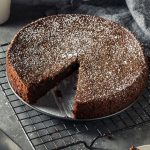
This stovetop adaptation of Nigella-style chocolate olive oil cake is deeply cocoa-forward, moist, and almost pudding-like at the center, with the fruity bitterness of extra-virgin olive oil balancing the sweetness. A gentle covered-pan cook mimics an oven’s enclosed heat, producing a tender crumb and a glossy, dark finish that slices cleanly once cooled.
- Prep Time: 20
- Cook Time: 40
- Total Time: 60
- Yield: 4 1x
- Category: Main Course
- Method: Stovetop
- Cuisine: International
Ingredients
- 1 tbsp olive oil, for greasing the pan
- 1 cup all-purpose flour
- 1/2 cup unsweetened natural cocoa powder, sifted
- 1 tsp baking soda
- 1/2 tsp fine sea salt
- 1 cup granulated sugar
- 2 large eggs, at room temperature
- 1/2 cup extra-virgin olive oil
- 1 tsp vanilla extract
- 1/2 cup whole milk, at room temperature
- 1/2 cup hot water
- 2 oz dark chocolate, finely chopped, for garnish
Instructions
- Lightly coat the bottom and sides of an 8-inch round cake pan or a 7-inch deep stovetop-safe baking tin with 1 tablespoon olive oil. Line the base with a round of parchment paper if you have it, which helps the delicate cake release cleanly after steaming-dry stovetop cooking. Set a large, deep skillet, Dutch oven, or wide pot on the counter and make sure it has a tight-fitting lid.
- In a medium bowl, whisk together the all-purpose flour, sifted cocoa powder, baking soda, and fine sea salt for 30 to 45 seconds. This evenly distributes the leavening and breaks up cocoa lumps so the batter stays smooth and rises uniformly. Do not skip sifting the cocoa, because compacted cocoa can leave dry pockets in the finished cake.
- In a separate large bowl, whisk the granulated sugar, eggs, extra-virgin olive oil, and vanilla extract until the mixture looks glossy and slightly thickened, about 1 minute. You are not trying to whip in a great deal of air, only to emulsify the oil with the eggs so the crumb bakes up even and tender. Scrape the bowl well so no streaks of egg remain at the bottom.
- Whisk the whole milk into the egg mixture until fully incorporated. Add the dry ingredients in two additions, whisking gently after each just until no flour remains visible. Overmixing at this stage can make the cake slightly tough, so stop as soon as the batter is uniformly dark and smooth.
- Pour in the hot water in a steady stream while whisking slowly until the batter loosens and turns glossy. The batter will seem quite fluid, which is correct for a moist chocolate olive oil cake and helps it cook through gently on the stovetop. If you see small cocoa specks clinging to the sides, scrape and fold them in with a flexible spatula.
- Transfer the batter to the prepared cake pan and tap the pan firmly on the counter 2 to 3 times to release any large trapped air bubbles. Place a folded kitchen towel or paper towel under the pot lid to catch condensation, keeping drips from marking the surface of the cake. This simple step helps mimic the dry top heat of an oven.
- Set a heatproof rack, metal cookie cutter, or canning ring inside the large skillet or pot, then place the filled cake pan on top. Cover the pot and cook over low heat for 35 to 40 minutes, adjusting as needed to maintain a very gentle environment; the cake should not sizzle aggressively. You want faint, steady heat so the center sets before the bottom overbrowns.
- After 30 minutes, quickly uncover and test the cake by inserting a skewer into the center. It should come out with a few moist crumbs but no wet batter, and the top should look matte rather than shiny and liquid. If needed, re-cover immediately and continue cooking 3 to 5 minutes more on low heat.
- Remove the cake pan carefully from the pot and set it on a wire rack to cool for 15 minutes. Run a thin knife around the edge, then invert the cake, peel off the parchment if used, and turn it right side up again. Let it cool at least another 20 minutes before garnishing, because the crumb is fragile while hot.
- Scatter the finely chopped dark chocolate over the warm cake so it softens slightly, or leave it as a textured garnish if you prefer a cleaner finish. Slice with a thin sharp knife, wiping the blade between cuts for neat portions. The flavor improves as the cake cools, when the olive oil and cocoa settle into a fuller, more rounded taste.
- For a primary oven alternative, bake the prepared batter in a greased 8-inch round pan at 350°F / 177°C for 28 to 32 minutes. The cake is done when the center springs back lightly and a skewer inserted in the middle comes out with a few moist crumbs attached.
Notes
Store the cooled cake tightly wrapped at room temperature for up to 2 days or in the refrigerator for up to 5 days. Freeze individual slices or the whole cake, well wrapped, for up to 2 months; thaw overnight in the refrigerator or for 1 to 2 hours at room temperature. To reheat, warm slices in a 300°F / 149°C oven for 6 to 8 minutes, or microwave each slice on medium power in 10-second bursts just until lightly warmed.
Nutrition
- Calories: 590
- Sugar: 54.9g
- Sodium: 458mg
- Unsaturated Fat: 6.3g
- Carbohydrates: 80.3g
- Fiber: 7.8g
- Protein: 8.8g
- Cholesterol: 117mg
Keywords: Nigella chocolate olive oil cake, stovetop chocolate cake, olive oil cocoa cake, dairy free chocolate cake, one pan cake, international dessert cake
Find it online: https://chefnigellarecipes.uk/nigella-chocolate-olive-oil-cake/